

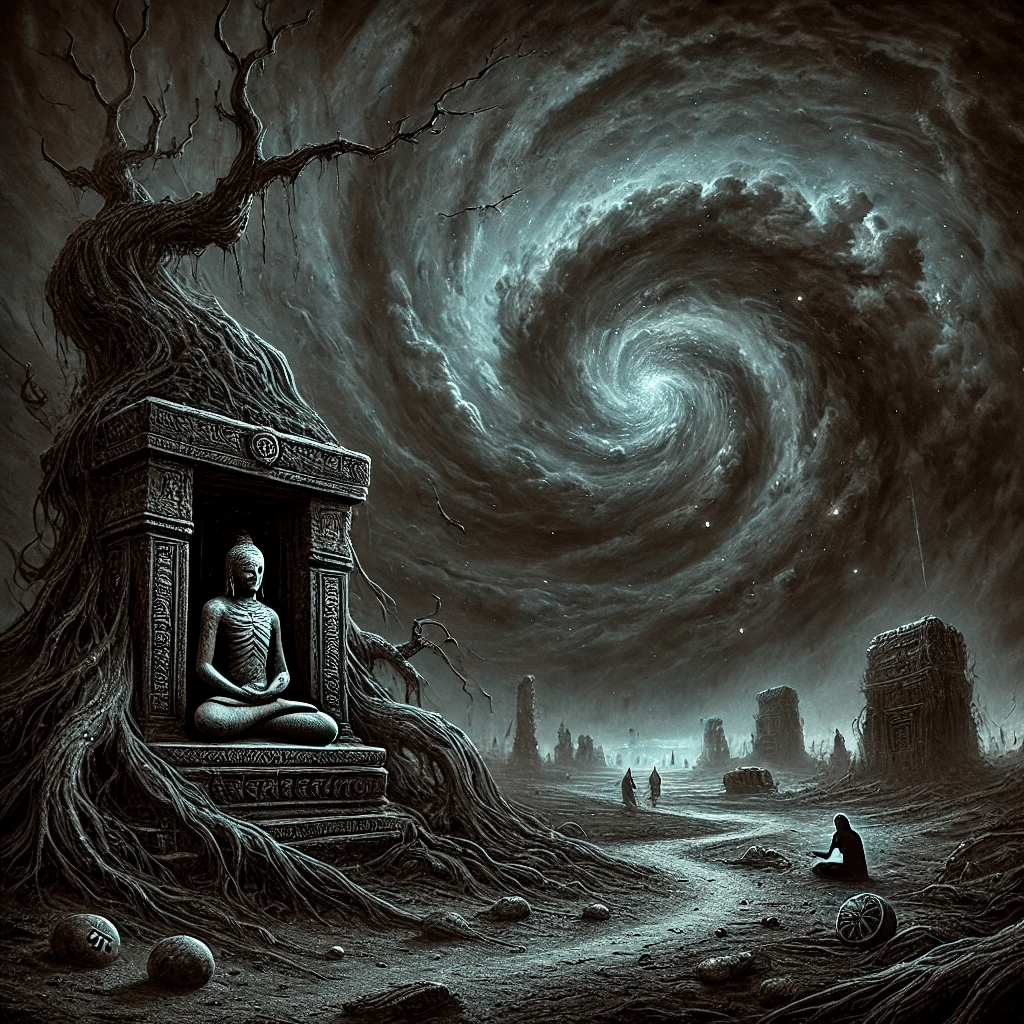
The Darkness of the Kali Yuga is intangible and immaterial. It is really the darkness of the soul. As spiritual beings, we naturally seek the good and the light. Our whole purpose is education and the unburdening of our souls within our physical bodies as we process a variety of emotions available to us in our lifetimes. The aspect of darkness within the Kali Yuga represents us forgetting our spiritual reality as we reject our spiritual natures.
We detach from the spiritual truths and our divine consciousness within the Darkness. The Vishnu Purana describes such a world within which “spiritual knowledge is lost, and men cease to perform sacred rites” (Book IV, Ch. 24). In the age of Kali Yuga, tamas dominate; it symbolizes spiritual darkness and delusion. “Tamas, born of ignorance, deludes all embodied beings. It binds through heedlessness, laziness, and sleep” (Bhagavad Gita 14.8). Thus, darkness signifies ignoring one’s true spiritual nature. When people forget their divine origin, they become trapped in material pursuits, laziness, and delusion. The internal darkness thus mirrors the external chaos of the Kali Yuga, where a lack of spiritual knowledge pervades society. Ultimately, the darkness of the spiritual is an internal manifestation of the Kali Yuga within us.
In Taoism, spiritual darkness stems from humanity’s disconnection from the Tao (the Way), the natural cosmic order. “When the Tao is lost, there is goodness. When goodness is lost, there is morality. When morality is lost, there is ritual. Ritual is the husk of true faith, the beginning of chaos” (Laozi Ch. 38). The Taoist view parallels the Hindu view of spiritual decline in Kali Yuga, where authentic spiritual wisdom is replaced by hollow religious rituals and external moral codes. Darkness thus arises when people abandon simplicity, humility, and the pursuit of inner balance.
In the Secret Doctrine, Blavatsky sees spiritual darkness as the loss of connection to the higher self through humanity’s obsession with material success and the neglect of the soul (Blavatsky 1888: 456). Resultantly, the lower self dominates as the soul’s higher faculties are suppressed due to material desires (456). Further, Blavatsky connected the fall of Atlantis to spiritual darkness, as she claims it was destroyed due to moral corruption and the misuse of spiritual powers (456). Spiritual truths become distorted, leading to humanity’s spiritual stagnation (497). Similarly, Lemuria was destroyed by natural disasters due to the loss of spiritual purity among the inhabitants (510).
Similarly, in Christianity, spiritual darkness is equated with sin and our separation from God. Jesus warns in John 12:35-36, “Walk while you have light before darkness overtakes you.” Saint Augustine viewed spiritual darkness as being enslaved by sin and ignorance of the divine grace (Confessions, Book VII). In Judaism, spiritual darkness is symbolized by galut (exile), representing distance from God because of collective sin. Isaiah repeatedly called for spiritual repentance during the dark times of moral decay (Isaiah 9:2).
Lastly, Buddhism discusses moha (delusion) as a spiritual darkness that prevents individuals from seeing reality clearly. The Buddha describes ignorance as the greatest source of suffering, “From ignorance arises craving; from craving, suffering” (Dhammapada Verse 273). And why should we crave when we are whole spiritual beings to begin with? Our current mass delusion that the spiritual is of no significance in Mahayana Buddhism is likened to the Degenerate Age (Mappo), a point in time when Dharma is increasingly forgotten.
Moments in history that exemplify this spiritual darkness include the suppression of spiritual teachings during the Inquisition and the Soviet-era religious bans. The burning of ‘witches’ to rid the way of older spiritual traditions, as well as the colonization and suppression of Native American spirituality and the forced conversion of children. The continual suppression of earlier religious traditions for newer ones further disconnects humanity from the source of the divine spiritual. Spiritually, the Kali Yuga is not evolutionary in the sense of upward progress and improvement. Instead, it is devolutionary, suggesting regression, decline, and decay as we further increase our reliance on materialism, especially computing technologies, moving away from nature. Today, the rise of spiritual apathy and the decline of religious practices is associated with the Darkness of the Kali Yuga.
 LUX PHARI YOGA
Leave a comment