

In Theosophy, the concept of “planes” refers to different dimensions or layers of existence. Each is associated with distinct states of matter and consciousness. The word plane is “the range or extent of some state of consciousness, or of the perceptive power of a particular set of senses, or the action of a particular force” (Theosophical Glossary). These planes co-exist, overlap in the exact spatial location, and interact indirectly through intermediary processes or substances.
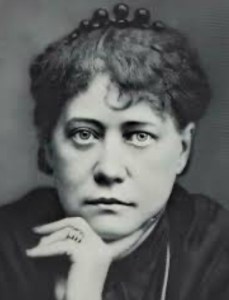
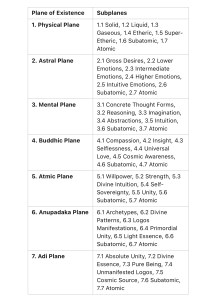
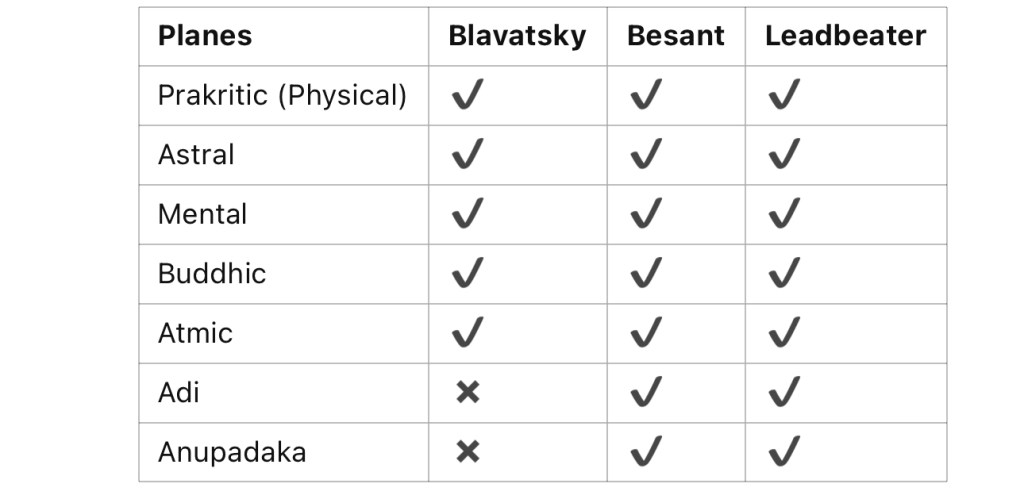
Helena P. Blavatsky emphasized that the planes represent a range of perceptive powers, forces, and corresponding states of matter or consciousness. Theosophy teaches that the universe consists of seven primary planes of existence, each containing seven subplanes, moving from the most material aspect (solid or gross desires) to the most refined and subtle (atomic essence). For instance, the first three subplanes of the physical plane (solid, liquid, and gas) represent the dense physical realm. At the same time, the higher four (etheric to atomic) correspond to subtler energy forms. Further, the astral and mental planes include the emotional and mental states that transition from lower, chaotic forms to higher, structured, abstract forms. Lastly, the higher planes Atmic, Anupadaka, and Adi represent increasingly spiritual and formless states of consciousness, culminating in absolute unity and divine essence.
Blavatksy frequently cautioned that the higher planes, especially the top three, were beyond the reach of ordinary human intellect. For instance, she noted that while the highest adept might begin their meditation (Samadhi) 0n the fourth macrocosmic plane (Buddha), they could only experience the full spectrum of Nirvana upon transcending the solar system (Collected Writings XII: 657). The hierarchical approach places human evolution firmly within the lower planes while aspiring toward higher ones.
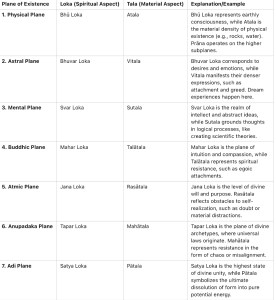
Blavatky’s framework integrates her understanding of the lokas and talas of esoteric Hinduism. Each cosmic plane has a dual nature: the loka (spiritual and the ethereal realms of consciousness and existence) and the tala (material characterized by denser vibrations or lower states of awareness). This dynamic interplay reflects the dual nature of reality itself (Blavatsky 1888). Just as lokas cannot function without talas, the spiritual aspect of a plane cannot exist without its material counterpart. As one ascends through the planes, one may overcome the denser forces of talas and align more with the spiritual forces of lokas. Both systems describe a path of descent into matter and ascent to spirit.
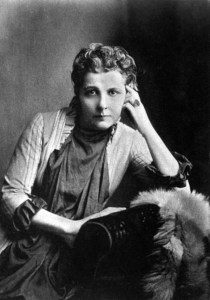
Later, Theosophical writers such as Annie Besant and Charles Leadbeater built upon Blavatky’s foundation, refining and expanding the doctrine of planes. Besant introduces the Adi and Anupadaka planes as distinct from the Atmic plane (Besant 1904). these planes represent pre-solar conditions and are linked to the Logos principle: Adi corresponds to the first Logos (unmanifested divine will), while Anupadaka aligns with the second Logos (formless spiritual essence). By defining these planes as independent levels, Besant provided a more precise roadmap for understanding cosmic evolution.
Leadbeater further justified this expansion through clairvoyant observation (Leadbeater 1911). He described the inhabitants and functions of planes in detail, emphasizing that higher planes serve as the blueprint for spiritual and material existence. For instance, he associated devas and advanced spiritual beings with the Buddhic and Atmic planes, highlighting their roles in human evolution.
Some benefits of the expanded framework include the possibility of a more comprehensive evolutionary model. The expanded version accounts for pre-solar conditions and the role of divine principles, offering a broader cosmological perspective. Also, the detailed descriptions of the planes and their inhabitants guide spiritual aspirants, particularly in meditation and ethical development. Third, incorporating Adi and Anupadaka aligns Theosophy with Hindu cosmology, enriching its universal appeal.
Some of the issues with the expanded framework are seen as it becomes overcomplicated and detracts from the simplicity and accessibility of Blavatsky’s teachings. Additionally, the reliance on clairvoyant claims raises questions about the validity of these additions, especially for skeptics. Lastly, the shift toward detailed cosmology risks overshadowing Blavatky’s emphasis on practical ethics and spiritual discipline.
Modern Theosophists have continued to explore and reinterpret the planes. Hodson, for instance, described how meditation and self-discipline enable the aspirant to ascend the planes, moving from the astral plane’s emotional turbulence to the Buddhic plane’s serenity and compassion (Hodson 1974). Furthermore, Mills argued that understanding the interpretations of planes fosters a sense of unity and responsibility, as actions on one plane reverberate through others (Mills 1990). This aligns with the Theosophical principle of universal brotherhood.
Blavatsky, Helena. P. 1888. The Secret Doctrine.
Blavatsky, Helena. P. 1980. The Collected Writings, Volume XII. Edited by Boris de Zirkoff.
Besant, Annie. 1904. A Study in Consciousness.
Hodson, Geoffrey. 1974. Theosophy: The Way to Wisdom.
Leadbeater, Charles. 1911. The Inner Life.
Mills, Joy. 1990. Reflections on the Ageless Wisdom.
 LUX PHARI YOGA
Leave a comment