

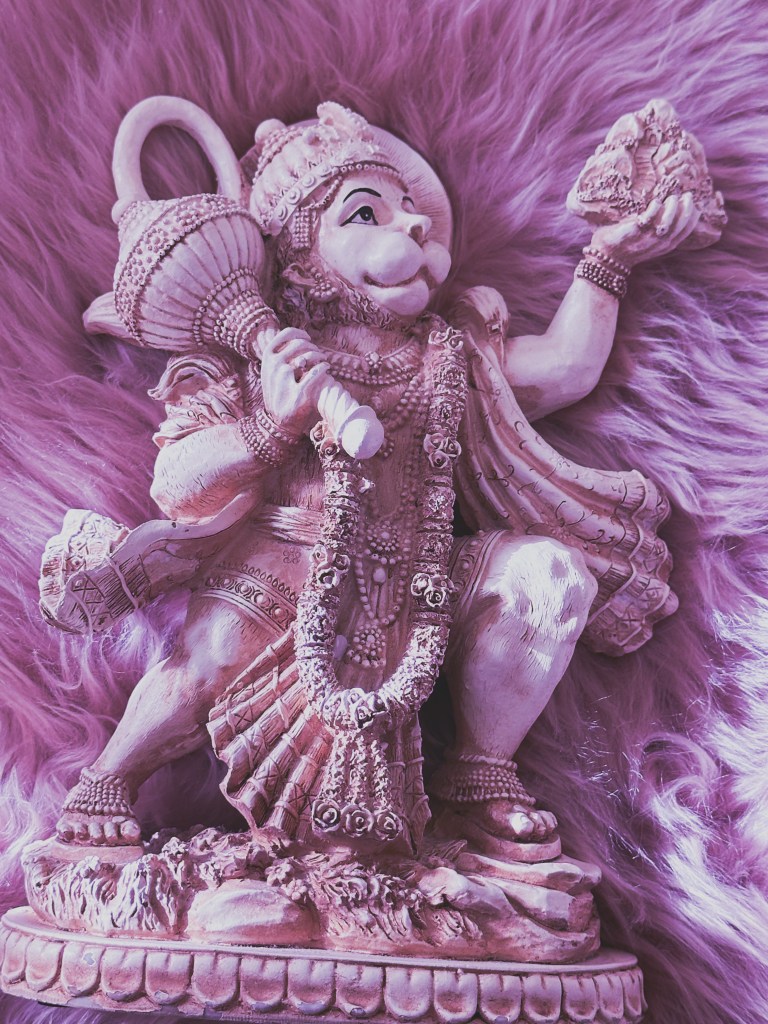
In contemporary Western yoga culture, studios increasingly strive for neutrality, often removing statues of Hindu deities, omitting Sanskrit chants, and reframing yoga as a purely physical wellness practice. This trend reflects a broader discomfort with religion and mythology in public spaces, driven by fear of alienating students unfamiliar with or resistant to spiritual symbolism. Yet this sterilization obscures yoga’s origins and erodes its philosophical depth. Yoga is not merely a fitness regimen; it is a sacred system embedded in Hindu cosmology, mythology, and devotional practice. Hindu deities, mantras, and chants are not ornamental relics but integral teaching tools that encode psychological insight, ethical principles, and spiritual transformation. To remove them is to extract yoga from itself, transforming a sacred tradition into a commercial product detached from its roots.
Mythology in Hinduism functions not as literal history but as symbolic language conveying metaphysical truths. Joseph Campbell explains that myths are “public dreams” that express universal psychological patterns (Campbell 13). Hindu deities embody archetypal forces within consciousness, providing accessible metaphors for complex spiritual realities. In yoga philosophy, these figures operate as teaching symbols that guide practitioners toward self-realization. The Bhagavad Gita presents Krishna not simply as a god but as the voice of higher consciousness guiding Arjuna through existential crisis (Easwaran 4). This narrative illustrates yoga as a lived myth, dramatizing the internal battle between ego and higher awareness. To practice yoga without acknowledging its mythic framework is to ignore the very language through which its wisdom is transmitted.
Patanjali’s Yoga Sutras, the foundational text of classical yoga, emphasize devotion to Ishvara, or the divine principle, as a path to liberation (Patanjali 1.23). This devotion, known as Ishvara pranidhana, directly invokes spiritual surrender. Commentators such as Edwin Bryant argue that Ishvara reflects the personal divine expressed through Hindu devotional traditions (Bryant 102). The inclusion of deities in yoga practice is therefore not extraneous but doctrinally supported. Mantras like “Om Namah Shivaya” or “Om Gan Ganapataye Namaha” are not cultural embellishments; they are vibrational technologies designed to attune consciousness to specific divine qualities (Feuerstein 211).
Ganesh, the elephant-headed remover of obstacles, exemplifies how mythology functions pedagogically within yoga. His symbolism teaches discernment, humility, and perseverance. Scholars note that Ganesh represents the muladhara chakra, governing grounding and survival instincts (Judith 56). Chanting his mantra before practice aligns the nervous system toward steadiness and intention. This is not religious indoctrination but symbolic psychology. Carl Jung described such archetypes as essential to individuation, arguing that mythological figures represent inner psychic realities (Jung 78). Thus, invoking Ganesh is a method of engaging subconscious processes that support growth and clarity.
Western studios often remove these elements out of fear of cultural offense, yet this erasure paradoxically contributes to cultural appropriation. Andrea Jain argues that modern yoga commodification strips away its ethical and spiritual frameworks, repackaging it as self-help fitness (Jain 67). When deities and chants are excluded, yoga becomes divorced from its cultural lineage. Authentic respect requires contextualization, not omission. Educating students about symbolism fosters inclusivity by deepening understanding rather than suppressing difference.
The sacred syllable Om illustrates how spiritual language has been diluted. The Mandukya Upanishad teaches that Om represents the four states of consciousness: waking, dreaming, deep sleep, and transcendent awareness (Radhakrishnan 598). Chanting Om is therefore a contemplative practice mapping the journey of awareness itself. Yet many practitioners chant without understanding its meaning, while others avoid it entirely to appear secular. This reflects what sociologist Wade Clark Roof calls “spiritual privatization,” where sacred symbols are stripped of communal meaning (Roof 122). Removing Om does not make yoga more accessible; it deprives practitioners of profound introspective tools.
Hindu mantra practice is grounded in Nada Yoga, the yoga of sound. Sound is believed to structure reality itself, as described in the Vedas (Feuerstein 194). Neuroscientific research supports the physiological impact of chanting, showing reductions in stress hormones and activation of the vagus nerve (Benson et al. 164). This demonstrates that mantra is not superstition but embodied neuroscience. Spiritual traditions understood this long before modern science confirmed it.
Furthermore, the yogic worldview recognizes divinity as immanent within the self. The Chandogya Upanishad teaches “Tat Tvam Asi” — “You are That” — affirming that the divine is not external but intrinsic (Radhakrishnan 447). Deity worship in yoga is not about external gods but internal archetypes. Shiva represents stillness, Shakti creative power, Saraswati wisdom. These energies mirror psychological states practitioners cultivate. Removing them flattens yoga into physical exercise, ignoring its transformative purpose.
The West’s discomfort with religious imagery often stems from Christian cultural conditioning that views deity worship as dogmatic. Yet Hinduism is non-exclusive and pluralistic. Diana Eck explains that Hinduism allows multiple paths to the divine, accommodating symbolic interpretation (Eck 92). Yoga emerged within this pluralistic environment. To demand neutrality is to impose Western secular norms onto a sacred Eastern tradition.
Yoga’s original purpose is moksha, liberation from suffering. As Georg Feuerstein emphasizes, asana was traditionally preparatory, not central (Feuerstein 45). Modern emphasis on postures alone reflects capitalist productivity culture, prioritizing performance over introspection. Deities, chants, and mythology counterbalance this by inviting reverence, surrender, and reflection.
By excluding spiritual elements, studios inadvertently reinforce colonial narratives that extract value while discarding origins. Decolonizing yoga requires restoring its philosophical and devotional components. As Shreena Gandhi notes, authentic yoga practice must acknowledge Hindu roots to prevent erasure (Gandhi 211). This does not require conversion, only respect.
Ultimately, yoga is mythology in motion. Each posture embodies symbolic narratives of transformation. Hanumanasana reflects devotion, Virabhadrasana embodies righteous action, Natarajasana celebrates cosmic dance. These are not arbitrary names but living myths expressed through the body. When mythology is removed, yoga loses its soul.
Western practitioners need not adopt religious belief to engage respectfully with symbolism. As Campbell observed, myth belongs to humanity, not dogma (Campbell 5). Understanding yoga’s mythological framework deepens practice and fosters cultural appreciation. True inclusivity does not sanitize tradition but honors it through education.
Yoga’s deities, mantras, and chants are not obstacles to accessibility; they are gateways to wisdom. By embracing their symbolism, practitioners reclaim yoga’s original purpose: union with the self, the cosmos, and the sacred. To remove them is to dilute a lineage thousands of years in the making. Yoga deserves more than neutrality. It deserves reverence.
Works Cited
Benson, Herbert, et al. The Relaxation Response. HarperCollins, 2000.
Bryant, Edwin. The Yoga Sutras of Patanjali. North Point Press, 2009.
Campbell, Joseph. The Power of Myth. Anchor Books, 1988.
Easwaran, Eknath. The Bhagavad Gita. Nilgiri Press, 2007.
Eck, Diana L. India: A Sacred Geography. Harmony Books, 2012.
Feuerstein, Georg. The Yoga Tradition. Hohm Press, 2008.
Gandhi, Shreena, and Lillie Wolff. American Yoga. Routledge, 2017.
Jain, Andrea. Selling Yoga. Oxford University Press, 2015.
Judith, Anodea. Eastern Body, Western Mind. Celestial Arts, 2004.
Jung, Carl. The Archetypes and the Collective Unconscious. Princeton University Press, 1981.
Patanjali. The Yoga Sutras. Translated by Swami Satchidananda, Integral Yoga Publications, 2012.
Radhakrishnan, Sarvepalli. The Principal Upanishads. HarperCollins, 1994.
Roof, Wade Clark. Spiritual Marketplace. Princeton University Press, 1999.
 LUX PHARI YOGA
Leave a comment